
Move the ticket. Change how it is billed. Watch the report change with it.
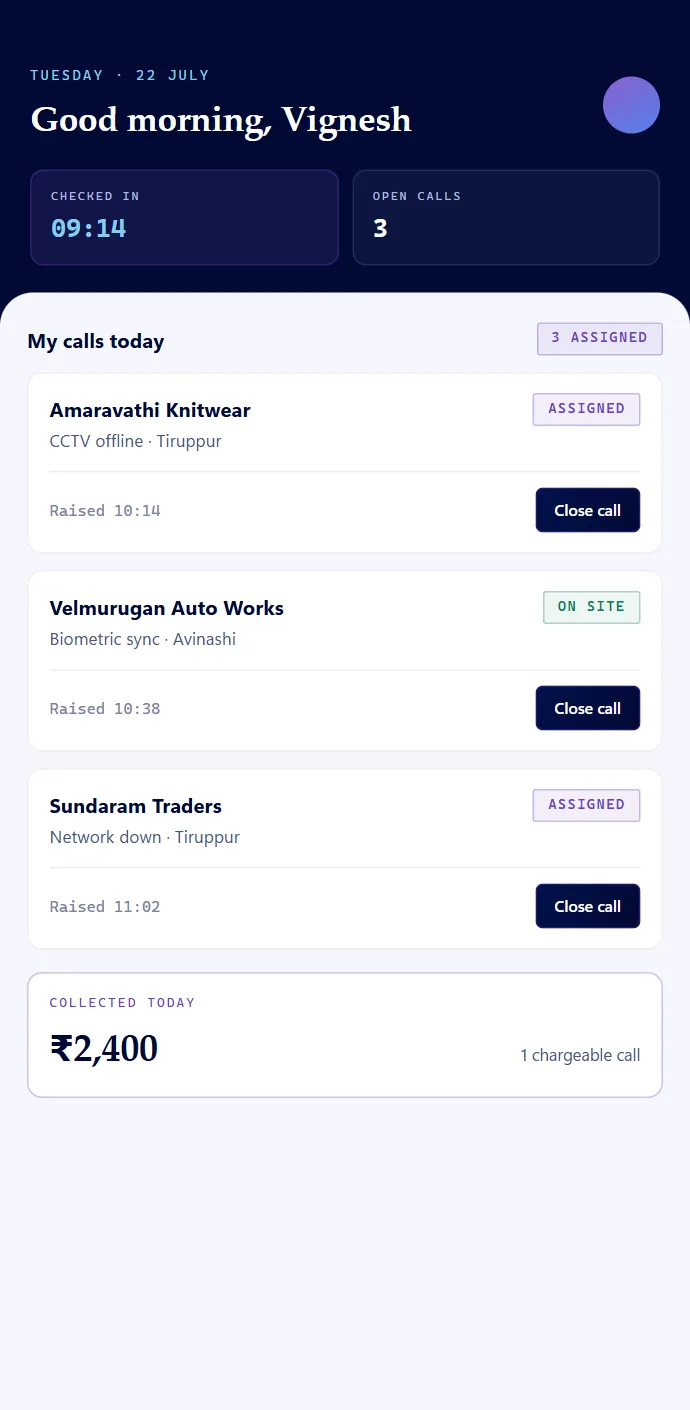
Raise, assign, attend, close
- 01
Raised, from anywhere
A branch raises its own ticket, a customer calls, or it comes out of the dispatch board. Same record either way.
- 02
Assigned and tracked
Who assigned it is stored alongside who it went to, so dispatcher and technician performance are separable.
- 03
Material, if needed
Repairs and RMAs get their own tracking, including third-party turnarounds that go overdue on somebody else's clock.
- 04
Closed with a report
The close-call report is required, not optional, and its shape changes with the billing classification.
Three jobs, not one
The classification is not a label added afterwards for reporting. It changes what the closing form asks for and what the customer receives.
- Chargeable
- Collects an amount and a payment method, and feeds the collections follow-up.
- Warranty
- Records the covering claim; no amount is collected and none is chased.
- AMC
- Draws against the contract and counts toward the visits that contract includes.
- Multi-branch
- Each branch sees its own queue. Launched at Coimbatore and added to from there.
- Material
- Repair and RMA items tracked separately, with alerts when a third party runs long.
It does not stop here
These are modules of one system, not products sold separately. The next two are the ones this module touches most.
Asked often enough to answer here
Why force a report on every close?
Because the close is the only moment the details are still in someone's head. A ticket closed without one is a ticket you cannot bill or learn from.
Can a branch see other branches' tickets?
No. Queues are isolated per branch; management sees across them.
What about equipment sent away for repair?
That is the material tracking. It holds the item, the third party and the expected return, and raises an alert when the return is overdue.
Walk a ticket to close
Change the classification and watch the closing form change with it.